

 EN
 Chinese CN

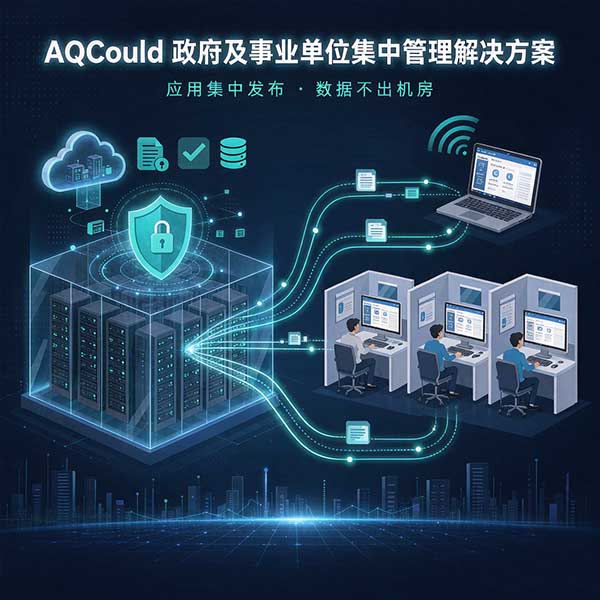
AQCould Centralized Management for Government & Public Institutions
I. Background
Government digitalization is the prerequisite and foundation of digitalization across society as a whole; government must lead by example and thereby drive the digitalization of the whole society. E-government has always been a priority of China's digitalization work, with government taking the lead to drive economic and social digitalization. This means e-government will remain one of the most important areas of digitalization for years to come. Government digitalization includes internal collaborative office work and open government affairs, with collaborative office being the foundation.
With the rapid development and widespread use of IT, digitalization has penetrated every industry and government IT has grown quickly. Internal application models in government agencies and public institutions have evolved into dynamic, large-scale and complex models based on E-Mail, OA and video conferencing. What clients carry is increasingly complex and diverse, network traffic keeps growing and bandwidth bottlenecks worsen, wasting valuable bandwidth, slowing access to critical business applications and invisibly raising IT maintenance costs. Therefore, understanding, managing and optimizing the government IT environment has become the top prerequisite for government IT operations. **A secure, reliable and sustainable centralized management platform is the key element in ensuring the normal daily operation of government agencies.**
II. Requirements
1. **Support daily office work and information exchange with external networks**: internal office systems need to exchange information with the government extranet, maintaining external information and handling public affairs while keeping the exchange secure and controllable;
2. **Eliminate information silos**: functional information systems cannot be shared on one platform and are mostly independent silos lacking unified management and planning;
3. **Incomplete functions, untimely information updates, lack of interactivity**: information systems act independently and data is scattered, making a real-time, unified business view hard to achieve;
4. **Growing need for mobile office**: official travel, cross-department collaboration and access by geographically remote subordinate units all require convenient and secure remote access;
5. **Traditional remote access is outdated**: many government agencies still use traditional "remote dial-up" for remote site access, with poor speed and quality and inadequate security.
III. The Solution
**AQCould Remote Software Cloud Platform** uses server application virtualization to build an infrastructure where internal business systems run centrally and are accessed in a controlled way: OA, collaborative office, business approval and other applications are installed centrally on servers in the institution's machine room; departments, subordinate units and staff on the move only need an AQCould client to operate the applications they are authorized for after login. **Applications are published centrally, avoiding repeated installation, configuration and updating on every PC, cutting substantial costs, improving efficiency and greatly simplifying deployment and management of complex computing environments.**
It is a computing model in which applications are **** installed, managed, supported and executed on the server, and it enables secure, fast data transmission so that WAN users achieve LAN-equivalent access, lowering bandwidth requirements and completely solving the e-government problems of "slow application connections and hard-to-guarantee security." Its advantages center on four aspects: quick and convenient deployment of all kinds of applications, assured connectivity among branches, flexibility of mobile office, and data security.
Implementation details:
1. **Deploy one server in the institution's machine room** with the AQCould server and the client programs of all business systems; use AQCould's application publishing to distribute systems to users network-wide by department and by role;
2. **Staff at subordinate units and branches** need no business system clients on their PCs — just the AQCould client (one file); enter the server address and account to access published applications quickly. Accounts support batch creation, with permissions assigned precisely by department and by post.
IV. Application Value
1. One unified platform, integrated information resources
All scattered departments and subordinate units are connected to the AQCould server, improving information flow efficiency in government affairs and enhancing internal operations and external service capability. All business systems are accessed on the same platform under account-based control, and business access and file exchange between internal and external networks are subject to file control and operation auditing, gradually forming a standardized, fully featured, secure and reliable e-government information platform that effectively integrates information resources and eliminates silos.
2. Fast access to critical applications from any location and any network
Staff working outside the office or at remote subordinate units can quickly access critical internal application resources at any time, from any place, over any available network connection, with an experience identical to working in the office. This not only saves significant access costs but also makes communication and management more convenient, fast, immediate and accurate.
3. Data stored centrally, aggregated in real time
Through the AQCould client, all business data is stored centrally on the institution's servers with unified backup and management. Data from all departments can be combined at any time into real-time summaries, making information updates timely and interaction strong.
4. Account-based permissions safeguard data confidentiality
All application access requires an account, and applications are assigned by department and by role: unauthorized users cannot access the corresponding business systems, let alone the sensitive data inside them. Together with file access control, process control and operation-by-operation auditing, sensitive data stays on the institution's servers, ensuring confidentiality and traceability by design.
5. Smooth operation even at low bandwidth
Ordinary broadband is enough (tens of Kbps deliver smooth operation), so notices, documents and instructions from higher-level departments reach and are processed by lower-level departments in a timely way, reducing excessive reliance on leased lines and sharply cutting network access costs.
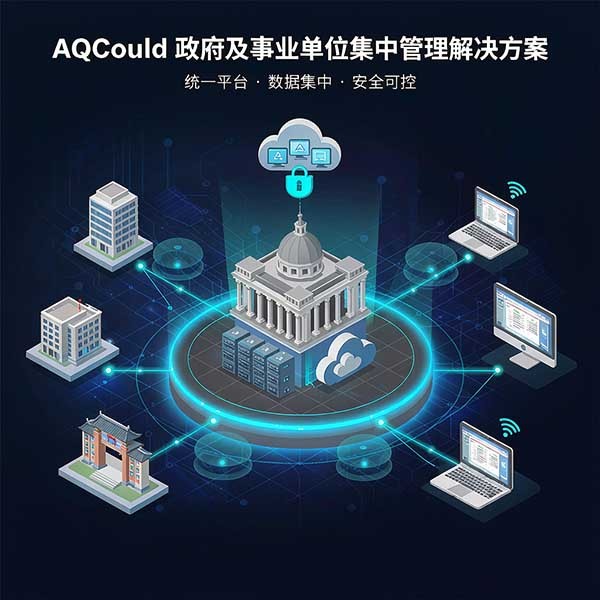
AQCould Remote Software Cloud Platform — no code changes, bringing government business systems safely onto a unified platform reachable across the whole network.

