

 EN
 Chinese CN

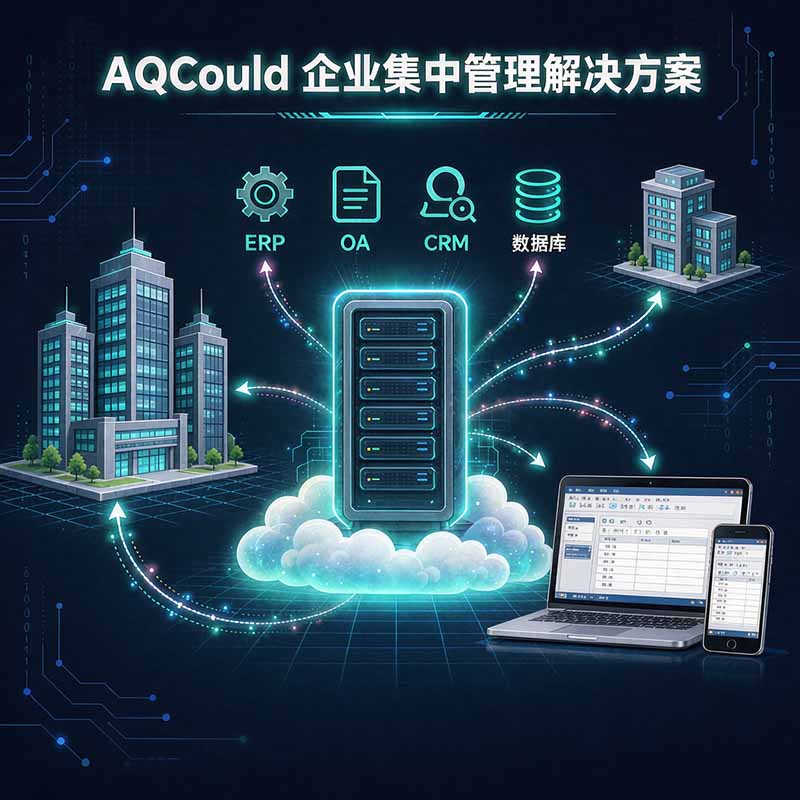
AQCould Enterprise Centralized Management Solution
I. Problems Facing Enterprises
Every manager about to implement an information system hopes to use IT to optimize the company's management structure and information processes, improving efficiency and reducing costs. Such adjustments do not necessarily require reorganizing the company; IT can build a "virtual organization" that changes the path of information flow and shares more resources, thereby making the existing structure more effective.
As managers of large enterprises, we often face this pressure: as the company grows, headquarters sits at the top of the management pyramid and can only learn about frontline operations through layers of reports. That brings a series of problems:
1. Information is often out of date
Collecting data at the grassroots is a heavy manual task with hard-to-guarantee accuracy; a fairly complete report often takes a month. Even so, frontline departments (such as sales teams) invest large amounts of repetitive manual work every month just to complete it.
2. Information is often incomplete
Markets keep changing and the metrics for management analysis need frequent adjustment. Fixed monthly report formats cannot keep up, and a new data request often takes three days or even a week to fulfill. By the time we combine information from all sides to complete an analysis, the data is already stale.
Many managers are stuck for years in the loop of "ask for data, wait for data, data goes stale, ask again." In today's fast-changing market this seriously hurts the speed and accuracy of decisions and is no longer acceptable.
**The root cause lies in the traditional IT architecture of "software deployed separately and data stored separately."**
II. The AQCould Solution
**AQCould Remote Software Cloud Platform** uses server-based application virtualization: ERP, OA, databases and other applications are installed and run centrally on the server, while clients only display the screen. With a network connection, software and data can be deployed and managed centrally, delivering the benefits of consolidation, lower costs, stronger management and better security — and **without changing a single line of your existing software's code**.
With the AQCould application virtualization management platform, enterprises can deploy all kinds of applications centrally on servers, with upgrades and maintenance also handled entirely on the server side, greatly improving IT efficiency:
- **No more maintaining client PCs**: the client is just a login file — double-click and go, with no need to install, configure or upgrade each machine;
- **Far lower hardware requirements for clients**: computing happens on a well-equipped server, and old PCs only handle input and display. Savings on hardware purchases and upgrades are substantial, and a broken terminal can be replaced at any time without losing data;
- **Stricter and more flexible security controls**: AQCould's centralized architecture allows security to be enforced at more layers. Software runs on the server, so files and processes stay under control — file access can be limited to specified directories, network shares blocked, disk mapping toggled individually, child processes spawned by a program restricted, and .bat/.cmd scripts disabled. Every blocked action is audited and the administrator decides whether to allow it. At the same time this only governs the virtual applications and does not affect other applications on the terminal, so strict management can be applied exactly where needed;
- **Worry-free cross-network access**: an optional three-network interconnection relay server removes restrictions between headquarters, branches and mobile staff on different carriers; internal services work just as smoothly over the Internet.
On this foundation, AQCould delivers centralized management value in four areas:
1. Centralized management enables real-time data sharing
With AQCould, enterprises can share data and use applications in real time: all business software runs in one server environment, and headquarters and branches stay highly synchronized. The delay of "frontline spends a month collecting, headquarters spends another week analyzing" disappears completely.
2. Centralized management lowers costs
The company installs one copy of the software on the server, and other users access it from anywhere over the network. As long as the server runs stably and is backed up regularly, the whole system is maintained. The duplicated effort of installing, upgrading and troubleshooting software machine by machine and department by department becomes centralized operation of one server environment; single-machine software can even become a network version with unlimited users, with no need to repurchase or redevelop.
3. Centralized management truly flattens information
Centralized data management and use help flatten information, changing the old situation where "frontline holds detailed data while headquarters only sees summaries." Managers at headquarters can follow every detail at the sales site at any time, and decisions rest on first-hand, real-time information.
4. Centralized management enables data segregation through permissions
With a rigorous user and application permission mechanism, flatter information does not mean a flatter organization: the company keeps its existing multi-level headquarters and branch structure and achieves tiered information management by "creating users and assigning applications by account." For users, nothing changes — they log in to the client and double-click the applications they are authorized to use.
III. Deployment: Go Live in Three Steps
1. **Add applications**: after installing the server, add the exe files of your existing software and choose whether they should run with administrator rights;
2. **Create users and assign applications**: tick the applications to assign to each user and save; bulk add is supported for large numbers of accounts;
3. **Users log in to the client**: download a single client file, enter the server address and account, and after login users see the applications assigned to them.
IV. Conclusion
With mature networks and virtualization proven at scale, a centralized management architecture for enterprise information systems brings real value in flattening information, sharing data in real time, reducing overall cost and strengthening security and confidentiality. **AQCould Remote Software Cloud Platform — no code changes, bringing your existing software straight into the era of centralized management.

